How to Size a Tankless Water Heater at Englewood's Altitude
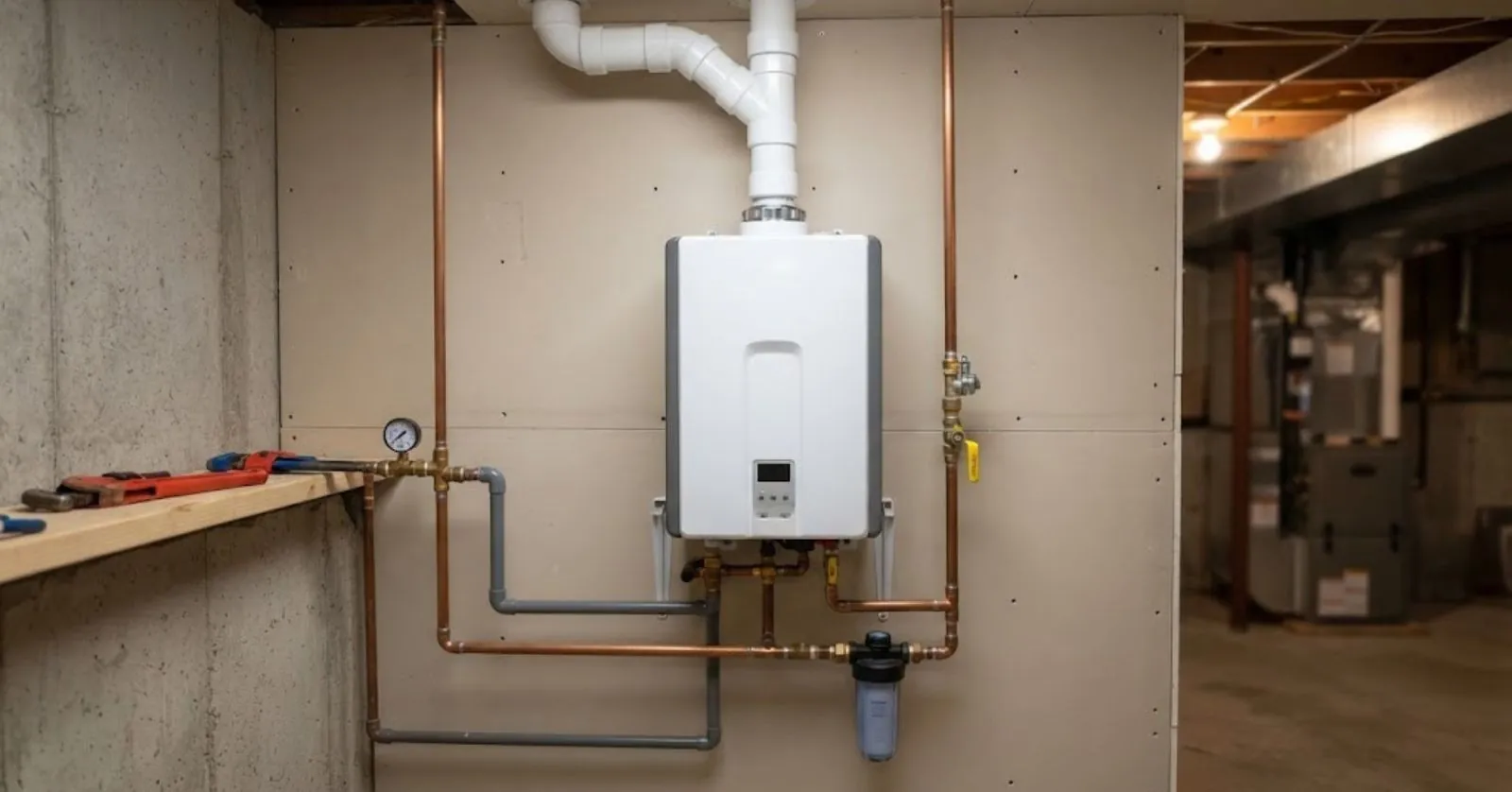
A tankless water heater that is too small gives lukewarm showers in January. One that is sized correctly at sea level can still come up short in Englewood, which sits at about 5,348 feet. This guide explains the two numbers that decide tankless sizing, how altitude changes the math, and what else has to be right for the heater to perform.
The two numbers that decide tankless sizing
Tankless heaters are sized by flow rate and temperature rise, not tank gallons. Flow rate is how many gallons per minute of hot water the household uses at its busiest moment. Temperature rise is how many degrees the heater must raise the incoming cold water to reach the set temperature, often around 120 degrees Fahrenheit.
Both numbers are worst in winter. Incoming water is coldest then, so the heater has to add more heat to every gallon, and a unit that keeps up easily in July can fall short in January.
Typical fixture flow rates
Since 2016, Colorado has required new showerheads and bathroom faucets sold in the state to carry the EPA WaterSense label, which caps their flow. These are typical figures for planning.
| Fixture | Typical flow | Notes |
|---|---|---|
| WaterSense showerhead | 2.0 gpm or less. | Older showerheads may use 2.5 gpm or more. |
| WaterSense bathroom faucet | 1.5 gpm or less. | Often less in practice. |
| Kitchen faucet | About 1.5 to 2.2 gpm. | Depends on the model. |
| Dishwasher | About 1 to 1.5 gpm while filling. | Short bursts. |
| Clothes washer on hot | About 1.5 to 2 gpm while filling. | Many cycles use cold. |
Add up the fixtures that realistically run at the same time. Two showers and a kitchen faucet is a common peak for a family home.
How altitude changes the math
At 5,348 feet, each cubic foot of air holds noticeably less oxygen than at sea level. A gas burner needs the right mix of gas and air, so appliances installed at altitude are set up to burn less gas than their sea-level rating, which reduces their heat output.
The traditional rule of thumb, found in many gas appliance manuals, is to reduce the input rating by about 4 percent for each 1,000 feet of elevation. Applied to Englewood, that is roughly a 21 percent reduction. Newer condensing tankless units with fan-controlled combustion often need less derating, and some manufacturers publish smaller figures or provide a high-altitude setting instead.
The practical takeaway is to size from the manufacturer's high-altitude output, not the headline BTU number on the box. A heater marketed at 199,000 BTU per hour may deliver meaningfully less in Englewood.
Thinking about going tankless?
We check your gas line, venting and peak demand before recommending a unit.
A worked example
Suppose the peak is one WaterSense shower at 2.0 gpm plus a kitchen faucet at 1.5 gpm, a total of 3.5 gpm. Assume winter incoming water around 45 degrees and a set point of 120 degrees, a rise of 75 degrees.
Heating water takes about 500 BTU per hour for each gallon per minute per degree of rise. So 3.5 gpm times 75 degrees times 500 is about 131,000 BTU per hour of output. A unit that is 95 percent efficient needs roughly 138,000 BTU per hour of input to deliver that.
Now apply altitude. If the manufacturer's manual calls for a 21 percent reduction, a 199,000 BTU unit delivers closer to 157,000 BTU of input at Englewood's elevation, which still covers this example. A smaller unit might not. This is an illustration, so use your own fixtures, your measured water temperature and the manual's figures.
What else has to be right
A correctly sized unit still performs poorly if these are wrong.
- Gas line size: tankless units draw far more gas while firing than a tank heater, and many existing lines are too small. Pipe sizing follows the International Fuel Gas Code (IFGC).
- Venting: most gas tankless units need their own vent, often direct-vent PVC or stainless, not the old chimney.
- Electrical: gas tankless units still need a 120-volt outlet or circuit for their controls and fan.
- Condensate: condensing units need a drain for acidic condensate, usually through a neutralizer, and the IPC (International Plumbing Code) governs how it discharges.
- Isolation valves: service valves under the unit make yearly descaling quick and inexpensive.
Gas line sizing is covered on our gas line installation and repair page, and the full replacement process is on our water heater installation page.
When tankless is not the best choice
Tankless heaters shine in homes that run out of hot water or need the space a tank takes up. They are less compelling when an existing gas line would need a long, expensive upgrade, or when the household rarely runs more than one fixture at a time.
Upfront cost is higher than a tank, and the savings come from not keeping a tank of water hot around the clock. In a small household with modest use, a new efficient tank or a heat pump model may pay back sooner. The right choice depends on your usage, not a general rule.
The cold water sandwich and hot water wait
Two complaints come up often after a switch to tankless. The first is a brief burst of cold water when a tap is turned off and on again, because the heater shuts down and restarts. It is a normal trait of many units and is reduced by models with a small internal buffer tank.
The second is a longer wait for hot water at distant fixtures, since there is no tank of hot water waiting near the tap. A recirculation setup, either built into the heater or added as a pump, shortens that wait, at some cost in energy. Both points are worth discussing before you choose a model.
Keeping a tankless heater performing
Englewood's water carries enough minerals that scale on the heat exchanger is the most common reason a well-sized tankless unit starts to struggle. An annual descale keeps output where it should be. What that visit includes is described on our tankless water heater service page.
If your water tests hard, a softener slows scale buildup and can stretch the time between descaling. It is worth testing before you decide.
Keep the model number, the installation date and the high-altitude settings used at install with your home records. Anyone who services the unit later will need them.
Larger homes in Greenwood Village sometimes run two tankless units in parallel, which makes gas line sizing even more important.
Sources
- Englewood, Colorado elevation (5,348 ft), Wikipedia.
- Manufacturer installation manuals, high-altitude derating sections.
- U.S. EPA WaterSense specifications for showerheads and bathroom faucets.
- Colorado Senate Bill 14-103, WaterSense requirement for plumbing fixtures.
This guide is general information for Englewood-area property owners, not a substitute for an on-site inspection. Utility programs and rules change, so confirm details with the agency named.