Sewer Line Replacement in Englewood, CO
Sewer line replacement is installing a new sewer lateral from the house to the sanitation district's main, replacing the old pipe along its whole length. It is the right call when the old line has collapsed, sagged badly or is damaged in many places. In Englewood, CO it is usually done by open trench or by trenchless pipe bursting, depending on what sits above the line.
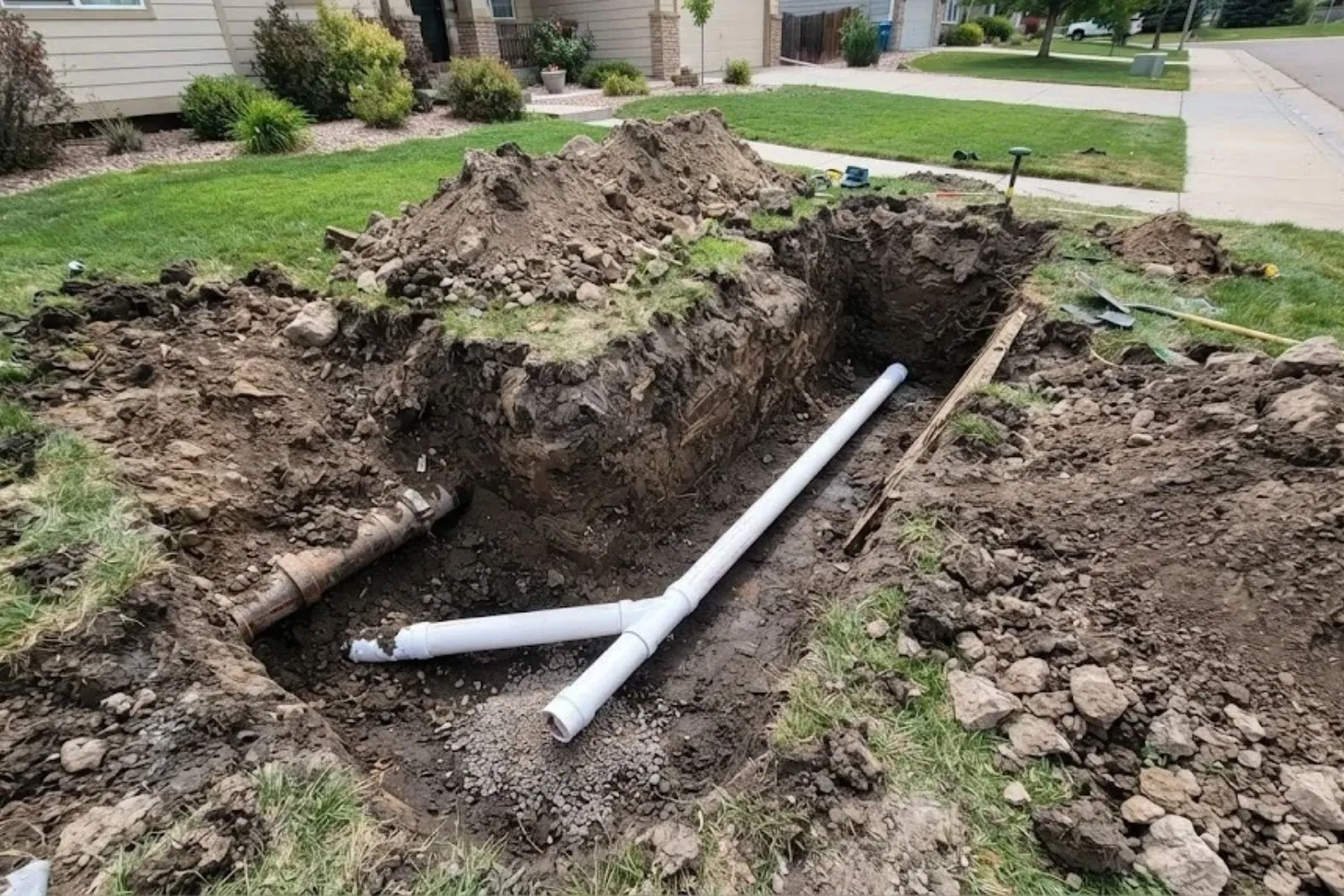
Replace the whole line, or repair part of it?
Replacement is a big decision, and it should be driven by what the camera shows. This is how we frame it.
| What the camera shows | Usual recommendation | Reason |
|---|---|---|
| One crack or root joint in sound pipe | Repair, not replacement. | A spot repair or liner fixes it for much less. |
| Several cracked or offset joints | Lining or replacement. | Lining works if the pipe is still round. |
| A belly holding standing water | Replacement of that section or the line. | Sags do not fix themselves and keep collecting debris. |
| Collapsed or crushed pipe | Replacement. | A liner needs a pipe to line. |
| Deformed fiber pipe | Replacement. | This material softens and flattens over time. |
If your footage shows only one or two defects, our sewer line repair page covers spot repairs and lining in detail.
Why so many Englewood laterals are reaching the end
Englewood's housing grew fastest after World War II, and city-data puts the median house build year at 1955. Sewer laterals from that period were commonly vitrified clay or cast iron. Clay comes in short sections joined every few feet, and each joint is a place for roots to enter or for the pipe to shift.
Some homes built nationally from the late 1940s into the early 1970s also used bituminous fiber pipe, often called Orangeburg. It was cheap and easy to install, but it softens and loses its shape as it ages. When a camera shows a flattened, blistered pipe wall, that is usually the cause, and it cannot be lined.
Many older Englewood streets are lined with large, mature trees. Their roots follow moisture to the joints of old laterals, which is why the same houses tend to call about backups year after year. Until a replacement is scheduled, hydro jetting can keep a root-prone line flowing.
Open trench or trenchless pipe bursting
Both methods produce a new, continuous line. The difference is what happens to your yard.
| Factor | Open trench | Pipe bursting |
|---|---|---|
| Digging | A trench along the full route. | Two pits, one at each end. |
| Driveways and trees | Concrete is cut and replaced, roots may be cut. | Usually passes under both. |
| Fixing grade problems | Can correct a sagging line. | Follows the old path, including its grade. |
| Cost | Often lower for short, shallow, open runs. | Often lower where surface restoration would be costly. |
Pipe bursting pulls a new plastic pipe through the old one while splitting the old pipe outward. It does not fix a line that was laid at the wrong slope, so the camera footage decides if it is suitable.
Told you need a new sewer line?
Ask to see the footage first. We will review it with you and price the options honestly.
A typical replacement from start to finish
- Review the footage. You see the defects and their locations and approve the method.
- Permits and locates. The work is permitted, the district's requirements for the tap are confirmed, and Colorado 811 marks buried utilities.
- Excavate. Pits or a trench are opened, and the connection points at the house and the main are exposed.
- Install. New pipe goes in with a cleanout near the house for future maintenance.
- Inspect and camera. The line is inspected, a final camera run confirms it, and the ground is restored.
Most residential replacements take one to three days, and the house can usually use its drains again each evening once the new line is connected.
What sets the price of a sewer replacement
Replacements are quoted from footage and a site visit. These factors move the number the most.
Length and depth
Longer and deeper laterals need more pipe, more excavation and sometimes shoring.
Method
Pipe bursting and open trench each win on price in different situations.
Surface restoration
Driveways, walks, retaining walls and landscaping above the line add cost.
Connection at the main
Work at the tap or in the street involves additional permits and requirements.
Cleanout installation
Adding an accessible cleanout is a small cost that saves money on every future service call.
Sewer line replacement is generally treated as maintenance and is not covered by standard homeowners policies. Separate service line coverage is sold by some insurers and utilities.
Want both methods priced for your yard? Call (303) 552-3896, day or night.
Sewer line replacement questions in Englewood
Ask for the camera footage and the measured location of each defect. A collapsed pipe, a long sag or damage along most of the line supports replacement. One or two defects in sound pipe usually do not.
Often, yes. Pipe bursting replaces the line through pits at each end and passes under driveways and trees. It is not suitable if the old line was laid at a bad slope.
Plan on one to three days for most homes, depending on length, depth and surface restoration.
In South Englewood Sanitation District No. 1, the lateral up to and including the tap is the owner's responsibility, so the district does not pay for its replacement. Other districts have similar rules.
The replacement itself is scheduled work. A collapsed line causing sewage to back up into the house is an emergency, and we can clear and bypass what we can 24/7 until the replacement is done.
Sewer replacement in Englewood and surrounding towns
We replace laterals throughout ZIP codes 80110 and 80113, including under the mature trees that line many of Englewood's post-war blocks. Properties in nearby Cherry Hills Village sit on larger lots, which can mean longer laterals where trenchless methods save the most landscaping.