Englewood's Lead Service Line Program: What It Covers and What Stays on You
The City of Englewood is replacing lead water service lines across its system, at no direct cost to the homeowner for the replacement itself. That is good news for a city where so many houses went up before 1960. It is also easy to misunderstand. This guide explains what the program actually replaces, what it leaves behind, and what an owner of an older Englewood home should do next.
What the Lead Reduction Program is
Englewood Utilities runs a multi-year Lead Reduction Program to remove lead service lines from its water system and replace them with copper. The city says water leaving its treatment plant is lead-free, but it can pick up lead from old service lines or plumbing inside a home. Homes built before 1960 are the ones most likely to have a lead service line.
Replacements started in 2024. The city has said the work will take several years, and that it will remove lead and galvanized steel service lines connected to lead. Local reporting has put the number of Englewood service lines expected to be lead or galvanized at about 3,000 out of roughly 11,000.
What to expect on replacement day
If your line is scheduled, a little preparation makes the day smoother.
- Clear a path to the main shutoff and the indoor meter, if you have one, so the crew can reach the connection point.
- Expect the water to be off for part of the day while the new line is connected.
- Move vehicles if the crew needs access to the curb or driveway area.
- Before drinking the tap water again, run the taps as the city's flushing instructions describe.
- Start using the city's free pitcher and filter for drinking water right away.
Who normally owns which part of the line
Outside the program, Englewood splits ownership of a water service line at the curb stop, a shutoff valve usually near the property line. The city owns the pipe from the water main in the street to the curb stop. The property owner owns everything from the curb stop into the home.
The meter can be inside the house or outside in a pit, depending on the property, and the ownership split is the same either way. That rule matters for any leak on the buried line in your yard, which is normally the owner's to repair.
What changes for a confirmed lead line
For a confirmed lead service line, the program replaces the entire line, from the main all the way to just inside the house, including the part the owner would otherwise be responsible for. Crews typically disconnect the old line, bore a new path underground, pull new copper through it and reconnect at the main and at the home's plumbing.
Want to know what is inside your walls?
A plumber can tell you in one visit if your interior pipe is galvanized, copper or a mix.
What the program covers, and what it does not
This is the practical line between the city's work and the owner's.
| Item | Covered by the program? | Notes |
|---|---|---|
| Lead service line, main to just inside the house | Yes, when confirmed. | Replaced with copper. |
| Galvanized line connected downstream of lead | Included in the removal effort. | Confirm with the city for your address. |
| Galvanized service line on a post-1960 home | No. | The city says these are not connected to lead pipe. |
| Supply pipe inside your walls | No. | Galvanized or lead-soldered pipe stays unless you replace it. |
| Faucets and fixtures | No. | Older brass fixtures can contain lead. |
The part that stays on you: interior plumbing
The program stops just inside the house. The city itself notes that lead can still be present after a service line replacement if the home's internal plumbing or fixtures contain lead or galvanized steel.
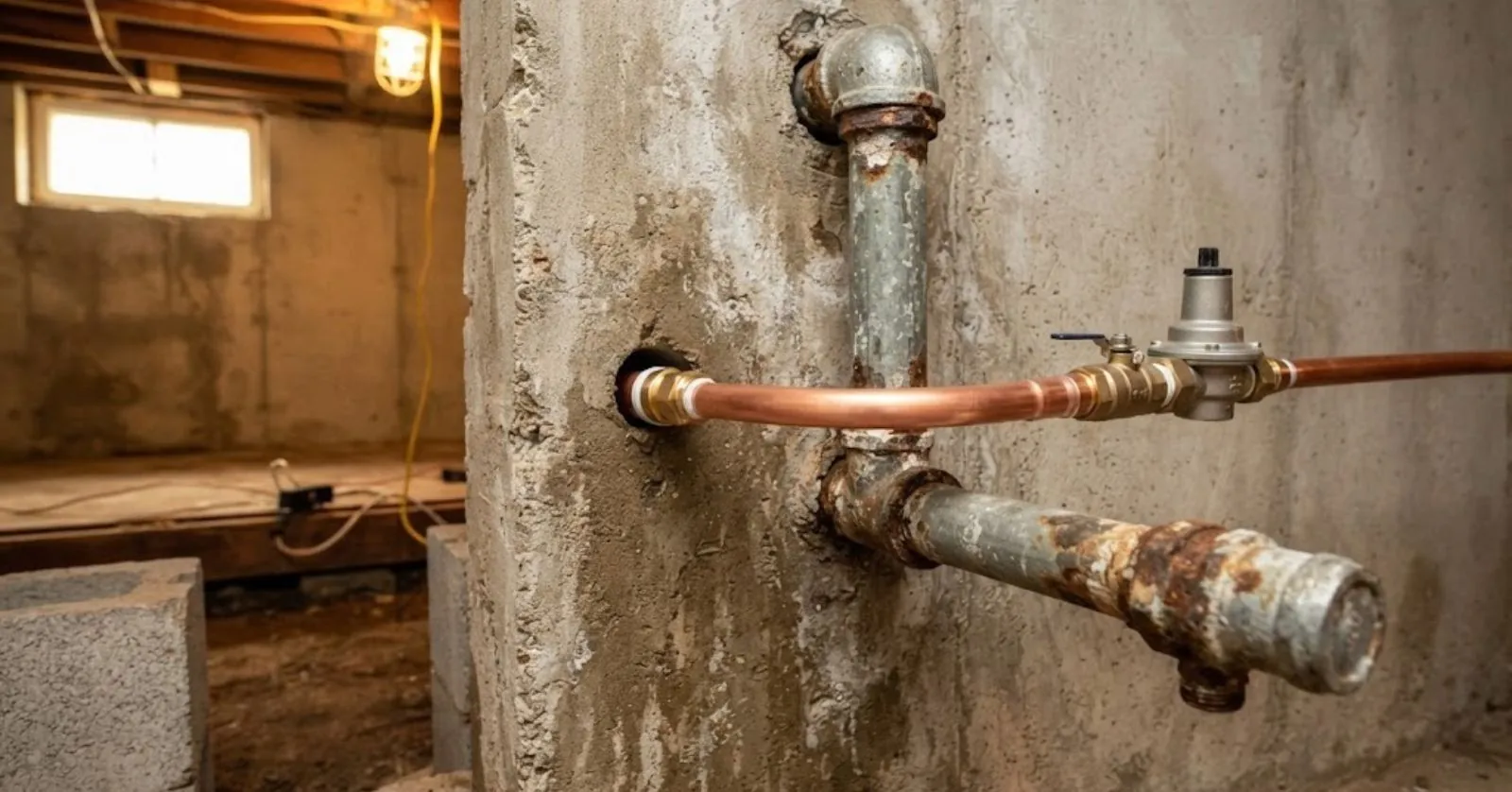
In a typical 1950s Englewood ranch or bungalow, that interior plumbing is often galvanized steel. Galvanized pipe is not lead pipe, but its inner surface can collect lead particles over decades from an upstream lead line, and it corrodes on its own. Older copper systems may also have lead-based solder at the joints, since lead solder was common before federal lead limits in the 1980s.
That is why the replacement is a natural time to look at what is inside the walls. If the interior pipe is galvanized and you are already seeing rusty first-draw water, falling pressure or weeping joints, a whole-home repipe addresses the part the program does not.
Post-1960 galvanized service lines
Many Englewood homes built a little later, in the following two decades, have galvanized steel service lines. The city states that galvanized lines on those later homes are not part of the program, because they are not connected downstream of lead pipe.
Those lines are still aging. Galvanized service pipe rusts from the inside, loses flow and eventually leaks underground. Replacing one is the owner's decision and cost, and it is covered on our water line repair and replacement page.
How to check your own line
You do not need to wait for a letter to find out where you stand.
- Search your address on the city's online service line inventory map, linked from the Lead Reduction Program page.
- If the map shows unknown or you disagree with it, request physical verification through Englewood Utilities billing at 303-762-2635 or lead@englewoodco.gov.
- Look at the pipe where it enters the house near the main shutoff. Lead is dull gray, soft and shiny when scratched. Galvanized is gray and hard with threaded fittings. Copper is orange-brown.
- Note what the pipe looks like just past the shutoff, since that tells you what the interior plumbing is made of.
Filters while you wait, and after
After a lead service line replacement, Englewood Utilities provides a free water pitcher and filter certified to remove lead, to use for six months. The city recommends certified filters for drinking water, for preparing infant formula and for cooking foods that absorb water, such as rice, beans and soup. Tap water is fine for showering, laundry and dishwashing.
If you are not in the program but have older interior plumbing, you can buy a filter certified to NSF/ANSI Standard 53 for lead. A filter installed under the kitchen sink is more convenient than a pitcher for daily use, and the options are laid out on our water filtration installation page.
Costs to plan for as an owner
The program itself does not bill the owner for a confirmed lead line replacement. The costs that remain are the ones outside its scope, and it helps to budget for them rather than be surprised.
The biggest is usually interior pipe. A whole-home repipe of a single-story house with a basement is a multi-day job, and the price depends on the number of fixtures, how many walls are finished, and the choice between PEX and copper. A partial repipe of the worst section is a lower-cost first step.
If your home has a later galvanized service line outside the program, its replacement is a separate cost driven mostly by the length of the run and what sits above it. A certified under-sink filter and its replacement cartridges are the smallest ongoing cost, and one worth paying while larger work is scheduled.
Homeowners insurance does not pay for replacing old pipe as maintenance. Some insurers do look more favorably on a home once galvanized supply lines are gone, so tell your agent when the work is done.
A sensible order of operations for owners
Start by confirming your service line material. If it is lead, the city's program will replace it, and you can plan interior work around that schedule. If it is a post-1960 galvanized line, budget for replacing it yourself when it starts to fail.
Next, look at the interior pipe. Galvanized interior plumbing in a 1950s home is usually near the end of its useful life regardless of lead. Use a certified filter for drinking and cooking in the meantime.
Finally, if water is leaking anywhere along the way, find it before opening walls. Leak detection pinpoints the source, which keeps any repair small.
Older neighborhoods just north of the city line face the same interior-pipe question under Denver Water's own program, which is why we cover University Park too.
Sources
- City of Englewood, Lead Reduction Program (engagement site).
- City of Englewood, Lead Reduction Program frequently asked questions.
- City of Englewood, What is the Lead Reduction Program?.
- KDVR, Englewood marks its 1,000th lead service line replacement.
This guide is general information for Englewood-area property owners, not a substitute for an on-site inspection. Utility programs and rules change, so confirm details with the agency named.