Replacing Galvanized Pipe in an Englewood Home: PEX or Copper?
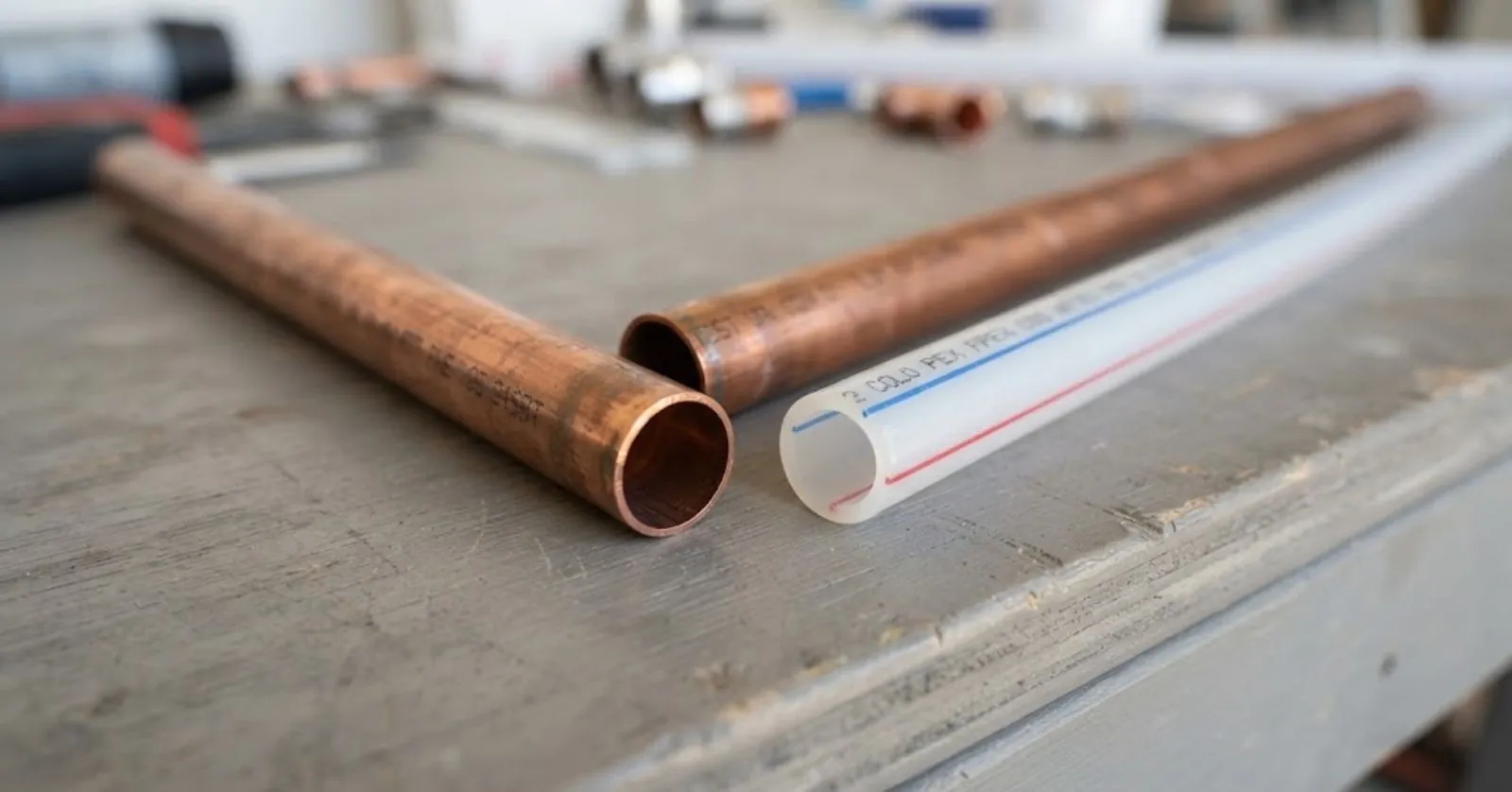
If your Englewood house was built in the decade or two after World War II, there is a good chance gray, threaded galvanized steel carries water to its faucets. That pipe was a sound choice when it went in. Decades later, it is often the reason for rusty water, weak showers and small leaks that keep coming back.
This guide covers how to tell when it is time, how to choose between PEX and copper, and how to plan the job so it disrupts the household as little as possible.
How galvanized pipe fails
Galvanized pipe is steel with a zinc coating. The zinc protects the steel for a long time, but it slowly wears away on the inside where water touches it. Once it is gone, the steel rusts, and the rust builds up as a rough layer that narrows the pipe a little more every year.
The weakest points are the threads. Cutting threads into the pipe removes part of the wall and the coating at every joint, so fittings are where leaks usually start. That is why a galvanized system tends to produce a string of small leaks rather than one dramatic failure.
Low pressure is the other common symptom. Because corrosion narrows every section, the fixtures farthest from the main shutoff, often an upstairs shower, lose pressure first.
Signs it is time to plan a repipe
One symptom on its own may be a simple repair. Several together point to the pipe itself.
- Rusty or brown water when a faucet is first opened in the morning.
- Pressure that has dropped gradually over the years, worst at distant fixtures.
- More than one leak at threaded joints in the last few years.
- Visible rust, mineral crust or weeping at fittings in the basement ceiling.
- A home inspector or insurer noting galvanized supply pipe.
PEX and copper side by side
Both are approved under the IPC (International Plumbing Code), which the Colorado Plumbing Code is based on. The differences are practical.
| Consideration | PEX | Copper |
|---|---|---|
| Installed cost | Usually lower. | Usually higher. |
| Installation speed | Faster, with fewer joints. | Slower, with more soldered joints. |
| Wall openings | Fewer, because it bends and fishes through bays. | More, because runs are straight. |
| Freeze behavior | Can expand somewhat before failing. | More likely to split when frozen solid. |
| Sunlight | Must be protected from UV. | Not affected. |
| Rodents | Can be chewed in rare cases. | Resistant. |
Not sure what pipe you have?
A quick look at the basement ceiling usually answers it. Call and we can check in one visit.
Choosing for a typical Englewood house
Many Englewood ranches and bungalows sit over a full basement, and in many of them the basement ceiling is still open or has a drop ceiling. That layout suits PEX well. A main trunk or a manifold goes in the basement, and individual lines run up through interior walls to each fixture group with small access openings.
Copper is a strong choice when a homeowner prefers it, when lines run through spaces exposed to sunlight, or when the house already has good copper in part of the system and the goal is consistency. It is also familiar to every buyer and inspector.
There are different grades of each. PEX comes in several types that use different fittings, and copper comes in different wall thicknesses. Ask what the quote specifies, since that affects both price and longevity.
What actually drives the price
Square footage matters less than people expect. The number of fixtures matters more, because every sink, toilet, tub, shower, hose bib, water heater and appliance connection is a run to install and test.
Access is the next biggest factor. A single-story house over an open basement is the simplest case. A finished basement, plaster walls, tile around showers, or a second story all add time to open and restore walls.
Two other items often join a repipe: the main shutoff valve and the pressure reducing valve, if there is one. Old gate valves and worn pressure valves fail as often as the pipe, and replacing them while the water is already off costs far less than a separate visit later.
Planning the work around your household
- Walk-through and written quote. Every fixture and access point is noted, and the material and scope are written down.
- Permit. Repiping is permitted work, so the permit is pulled before anything starts.
- Phased installation. New lines are run while the old ones still supply water, one area at a time.
- Switch-over. Each fixture group is connected to the new pipe, keeping water outages short.
- Pressure test and inspection. The new system is tested and inspected before walls are closed.
- Patching. Access openings are closed. Confirm up front whether finished drywall and paint are included.
Coordinating with the city's lead line work
Englewood's Lead Reduction Program replaces confirmed lead service lines from the main to just inside the house, but it does not touch interior pipe. If your home is on the list, it makes sense to schedule the interior repipe around the city's work so the new service line connects to new interior plumbing.
If your service line is galvanized and outside the program, replacing it at the same time as the interior pipe can save a mobilization. That work is covered on our water line repair and replacement page.
For the full details of an interior repipe, including permits and scheduling, see our repiping service. If you want to confirm where a current leak is before deciding, leak detection finds it without opening walls.
What to do if a galvanized joint starts leaking
Threaded joints on old galvanized pipe usually weep before they fail. These steps keep a drip from becoming a flood.
- Close the nearest fixture valve or the main shutoff and put a bucket under the leak.
- Do not try to tighten an old galvanized fitting with a wrench. Twisting it often cracks the corroded threads.
- Switch off power to any outlet or light the water is reaching, at the breaker panel.
- Photograph the leak and any damage for your records and insurer.
- Have the joint repaired and ask how the neighboring joints look, since they are usually the same age.
Living with galvanized until you repipe
Not everyone can repipe right away. In the meantime, run the cold tap for a moment before filling a glass in the morning, clean faucet aerators when flow drops, and keep an eye on joints in the basement ceiling for fresh rust stains or dampness.
Know where the main shutoff is and test that it turns. If a joint lets go, being able to shut the water off in seconds is what keeps a small leak from becoming a water damage claim. A certified filter at the kitchen sink is a sensible addition in older homes as well.
Many 1940s and 1950s bungalows in Denver's University Park are working through the same galvanized-to-PEX decision.
Sources
- City of Englewood, Lead Reduction Program frequently asked questions.
- International Code Council, Colorado adoption of the 2021 International Plumbing Code.
- City-data.com, Englewood, Colorado housing statistics.
This guide is general information for Englewood-area property owners, not a substitute for an on-site inspection. Utility programs and rules change, so confirm details with the agency named.